Friday, January 3, 2020

Happy Holidays!

Better late than never???  When I got back from traveling for the holidays, then recuperating (sort of) from the gift virus from my Memphis family, I discovered that I'd never posted this!  Oh, well, one less thing to worry about at the beginning of the year...

[Belated Post]
It sure is a busy time of year, isn't it?  We quilty folks have been sewing up a storm, as well as doing all the other things that need to be done for the holidays and in everyday-life-as-we-know-it.  I hope you've been productive and having fun, too!

Shortly after my last post (mid-October!?), the hubster and I headed out to San Francisco for some serious grandparent time.  Loads of fun, but exhausing.  With kids 5, 2-1/2, and 1 year old, not even a hand-sewing project got tackled.  (And did I mention that my son's dog had, um, lower intestinal tract problems?).

But before we left home, I did manage to sew up a big chunk of the selveges that I've been saving for a few years.  I finally figured out what I want to do with them.  And the first step was to sew them onto a muslin foundation sized for the project that I have in mind.

First I sorted the strips by length and color.  Little ones went into the bin that will eventually become stuffing for an ottoman.
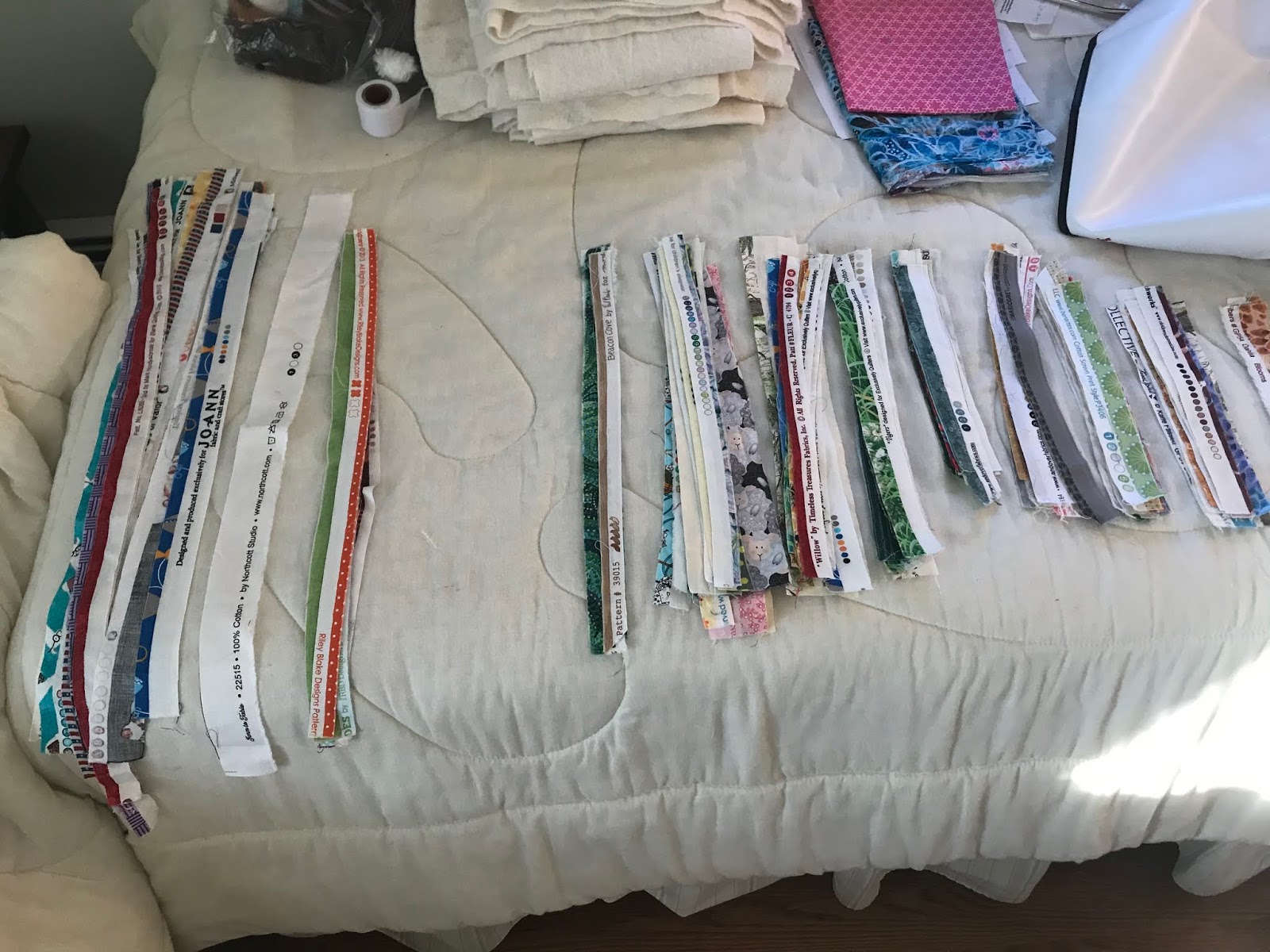

 Laying them out on a bed didn't work all that well.  The old wood drying rack that I got for my freshman year in college was the perfect tool for keeping the sorted selveges organized!


It was so much fun going through the strips and sewing them up!  There's some that Gina gifted to me from one one of her projects.  There are some blues from Janice.  Oh, that's from my Otsego Lake quilts!


All done for now trimmed and squared.  This was a test piece that I'd started in Michigan.  I downsized when I realized how many different length strips I'd need.


Once  the project pieces were done, I didn't want the drying rack hanging around.  Plus it's winter, and I'll need the rack for drying sweaters.  But lo!  What hanger through yonder closet shines?  Perfect for keeping the selveges organized(ish) while taking up nearly zero space.


File this under UFOs, but I have pulled fabric from my stash to continue after the holidays.

On the Small Project front, I made aprons for Christmas gifts.  They were super-easy, just cut from a panel and stitched up.  I did another stash-pull to line them.  Didn't bother with photos, but perhaps I'll get a pic of one of the recipients wearing his.

As for Large Projects, I've continued to plug away at the Ringo Lake quilt (see prevous posts on the sidebar).  I've been working on it exclusively at my Thursday morning quilt group, so progress has been slow but steady.
50 blocks done!  Now for the hard part -- squaring up.
Unusual for a Bonnie Hunter Quiltville pattern, in my experience, the instructions for completing the final steps were not very detailed, at least not as much as most of her other patterns.  Or maybe my intuition or experience failed me.  I finally had to sit down with a blown-up copy of the quilt and trace over it to figure out how things were supposed to come togther.  I'd already sewn sashing to several blocks incorrectly, so it was worth it to backtrack, unsew, and get it right before proceeding.


 30 blocks with individual sashing strips added to two sides (A).


 Remaining 20 blocks with no sashing (B)


A strips to the left, B strips to the right.

Starting to come together!  I'll do a full test layout when the A blocks are finished.  Then I'll plug in the rest of the sashing units, trying to avoid having the same coral fabrics right against each other.  Then I'll sew up full strips with the brown cornerstones and pull it all together.

We're off to Memphis for Christmas week, so again a hiatus in stitching.  Meanwhile, have a wonderful holiday.  See you next year!

Update January 3, 2020

No sewing got done in the last 2-1/2 weeks, but today I wanted to power through and get SOMETHING (anything!) done.  It was slow going, but by mid-afternoon I was getting back in the groove.  Yay!  I'm thinking that tomorrow I can finish sashing the sides of the Ringo Lakes A-blocks and make some headway on laying out all the blocks and the rest of the sashing strips.  I love the colors and the pattern but I surely will be glad to get this quilt top done.

I hope you enjoyed your holidays, and HappyNew Year to all!


Monday, October 14, 2019

Done! Done! Done!


Eight years in the making, the two Otsego (oversized) twin-bed quilts are finished!  So many lessons learned in this quilting journey from total novice.  Even at the end, between quilts #1 and #2, I learned a lot.

For example, with borders such as these (not mitered and quilted separately), quilt the shorter borders first, so they can nudge the longer ones back from the seam if necessary.  That way you don't end up with a fold along the seam line.  Even though I was using a walking foot and had measured the borders carefully, the weirdness of the (unintentionally) wonky blocks caused a lot of fabric build-up along the way -- build-up that even the walking foot couldn't compensate for.

No SilkPurse from This Sow's Ear!

If you remember, I designed these quilts in a program (kind of like EQ, but available for a Mac; I've since abandoned it for EQ8, now available for Macs).  Anyway, I didn't know what a flying goose was, and just bumbled along.  Cutting and sewing were rather poor.  When it came time to stitch-in-the-ditch along the first border, the fabric gathered badly along the flying geese (among other places).


Although I pre-washed all the fabrics in these quilts, I like to think (hope!) that the wrinkles, puckers and pleats will just add to the homey, hand-made feeling.  I tried mightily to smooth everything out, but my efforts were mostly in vain.

For the binding I chose a dark red that fits with the reds in the quilt top (though darker) and works nicely with the ladybugs in the backing.


This is the first time that I machine-stitched both sides of the binding, and I hate it!  The edges on the back are uneven (of course, I picked a nice area to photograph!).  Parts of the backing and even the batting poked through, and I had to rip out about 50% or more of the backing and re-stitch it.  Arghhh!  Thought I was saving time...  not!


In any event, everything is as done as it's going to get.  I *LOVE* this backing fabric.  If it were up to me, I'd probably put the backing side up!

I plan to whip up a couple of pillow shams with the leftover fabric, and then ship everything off to my brother and sister-in-law to haul up to the cabin in the spring.  By then I'll probably be over the detail-angst and will be excited to photograph the quilts on the beds.

On to the next adventure!

Wednesday, September 25, 2019

Making Waves!

Hi, everyone, and happy National Sewing Month!  And guess what...   I treated myself to a new sewing machine!


I got my Brother NX-650Q nine years ago just after I retired and had decided to learn to quilt.  It's a good machine -- I'm planning on keeping it -- but the harp space is way too small to quilt even a twin-size quilt, especially if one is stitching in the ditch on the diagonal.  I was replacing a 35-year-old Kenmore, and I did a lot on on-line research to figure out what I wanted at a price that seemed reasonable.  (BTW, I wish I'd kept the Kenmore, with its single-hole needle plate and strong engine).  Oh well.  I LOVED the Brother.  It came with a large extension table, a gazillion feet, a ton of stitches, including alphabet.  I was in awe.

But over time, as I did more quilting, I became aware of its limitations.  In addition to the small harp space, the motor just didn't have enough strength to power through heavy seams, and the zig-zag needle plate just sucked up triangles.  Single-hole plates are $$.  Earlier this month I decided that it was time to quilt the Otsego Lake quilts.  It was so frustrating!  The walking foot and/or the needle would stall where flying geese came together at the points.  The thread kept breaking.  The vibration caused screws to come loose, causing the needle to drop and break and the walking foot to come apart.  Garrrr!  Yes, most problems were resolvable, but still...

Again I did some internet research, this time with more understanding of what I needed.  My friend Deb told me how much she loves her Janome Memory Craft 6700P, and she does FMQ on huge quilts on hers.  Kelli, the owner of Riverhead Vac and Sew, offered me a very good price.  And the Janome has 3" more harp space horizontally than the Brother.   Not the biggest available, but just fine for me.  Ultimately, although I did find a couple of used machines on line, I decided that it was worth the extra money and peace of mind to buy from my local dealer.


My playground!  Janome standing confidently in the background, Brother in the table, Featherweight to the side.  I was so excited to get to work on the backlog of quilting.  I soon discovered that the Janome doesn't have a stipple stitch that I wanted to use, so she moved back and the Brother went back into the table for a little while.  Soon enough she came back out.  I keep my Featherweight set up on the side of my sewing table for opportunistic piecing.

Now, as National Sewing Month wraps up, I'm happy to say that one of the two twin-bed Otsego Lake quilts is quilted and ready for binding.


You may notice some (!) less-than-perfect points and seam matches.  This was the first "real" quilt that I had embarked on (not counting a baby quilt that was the product of a DVD-based how-to-quilt class).  The cutting was not very good, my sewing was not very good, etc., etc., you know the drill.  I squared up the top as best I could and started quilting and by stitching in the ditch along the diagonal lines.  But since there were few genuinely straight lines, things quickly got out of whack.  When I started stitching along the horizontal lines of the border, nothing wanted to stay flat.  And yes, I used a walking foot.  


There were pleats and folds everywhere.  I spent hours and hours trying to ease the fabric, with little appreciable improvement.  This afternoon I decided that I was wasting my time.  Step back!  Can you see it from the Mackinac Bridge?  Maybe when the quilt is washed, these won't be so noticeable.

So I decided to move on:  binding!  I'm not sure how that will go, either.  The edges are going to be very wavy.  But that's not a flaw!  It's a feature!  They represent the waves on the lake!

When you can't decide what to make, make excuses!

Wednesday, September 11, 2019

Crosstown Arts Quilt Show, Part 3

Memphis Blues


Last winter Crosstown Arts in Memphis sent out an invitation to quilters within a 200-mile radius of Memphis to submit one or more quilts for a summer show.  The only requirements were (1) the quilts had to be 24" square, and (2) they had to be blue.  Some were arty, some traditional.  There was a quilt by someone who also had a quilt in the Art Quilts show, one by a teenage boy, one by a group of kids.

The quilts were hung in columns of 3, so it was hard to get photos of the ones on top,  There were 230 in all!  I didn't take photos of all of them -- my poor phone was barely limping along at this point.  There was no handout with information about the quilts, so most are shown here with only my own comments.

I'll start with one of my two favorites and end with the other.  Enjoy them and everything in between!

Antarctica was created by a high-school boy.  What I truly love is that it is quilting in reverse.  Look closely -- this is a wholecloth quilt made with a single piece of white fabric.  As a geographer and a quilter, I was entranced.


A wholecloth quilt with beautiful free-motion quilting.

Close-up of the previous photo.

This was by a quilter who also showed in the art quilts exhibit.  You can see that the apparent curves are created by very small change in the sizes of the horizontal strips.


Yes, these are miniscule pieced squares, giving the appearance of a cross-stitch.


Close-up of previous quilt.

Captivating straight-line quilting.

Close-up of pineapple quilt above.

Needle-turn applique.  Wonderful quilting enhances the appearance of a koi pond.
This quilt held me for a long time.  How I wish that I could have learned more about how it was made and what inspired the quilter.  Machine- and hand-stitched, hand-appliqued and quilted.
Close-up of the girl fishing.
The fish in the river, considering the lure.

Satin fabric, machine appiqued and quilted.

Close-up of previous quilt.

A traditional sampler quilt with whimsical touches.


Beautiful use of similar fabrics to add depth.
Close-up of previous quilt.


Hand-stitching adds nice texture.


Use of alternative materials, both hard (shells) and soft (tulle) bring this quilt to life.

And finally, one of my favorites from this exhibit.  How can you not love the invention and humor while meeting the show's requirements.  Anonymous quilter, I love you!


I'm already hoping that the Crosstown Arts quilt show will become an annual event!  If it does, you can visit it here again next year!  


Thursday, September 5, 2019

Crosstown Arts Quilt Show, Part 2

Crosstown Arts Quilt Show, continued

Here are a few of the other art quilts from the quilt show that was held in Memphis, TN in June and July.  Again, the words are those of the quilters themselves.

SYO #32, Harue Konishi, Tokyo, Japan.

I wanted to take two-dimensional quilt works to the next level.  However, I did not want to achieve this by creating a concave-convex surface.  My idea was to create something that appears flat from which another world could emerge.  I let threads hang in front and in back, which created another space below.


Dutch Colors, Willy Doreleljers, Dordrecht, the Netherlands.

The windmill has traditionally been a striking presence in Dutch landscapes.  This work celebrates and old technology that still has bright prospects.  Hard lines and color contrasts bring to life the windmill's struggle against the elements.


Close-up of Dutch Colors

Realization, Karen Rips, Thousand Oaks, California.

It is believed tht the first sounds made by human beings was the Om, which is created by forming the mouth in the shape of an oval.  When ritualistically repeated again and again, it is poissible for one to come to a true state of consciousness or realization.


Crazed 16: Suburban Dream, Kathleen Loomis, Louisville, Kentucky.

We like to think we're masters of the univserse,  but really our civilization is a collection of six billion people held together by an increasingly fragile set of connections.  We neglect our children, our poor, and our homeless; we disrespect our government; we overstress the social bonds that should unite us.  What happens after some people achieve the suburban dream, while others remain in crowded cities?

Commercial cotton, machine pieced and quilted.

Wedding in the Wind, Jim Hay, Gunma, Japan.

I had recently watched a very windy outdoor wedding from my 9th flool Tokyo hotel room, and this is my interpretation.  The fallen priest reveals his skinny legs, the bride's father lose his wig, and the groom holds onto the wig but lets the bride blow away.  I included a self-portrait with my wife since we were celebrating 10 years of marriage that year.  We are hanging onto the edge of the quilt for dear life.


Close-up of groom holding ring while the bride is blown away.
The quilter and his wife.

The topsy-turvey priest.
Stay tuned for the final installment of the Crosstown Arts Quilt Show, with the local quilts made to meet the show's Memphis Blues criteria:  must include blue and be 24" square.